Humans Are Going Back to the Moon — And It Just Happened

At 6:35 p.m. EDT on April 1, 2026, NASA's Space Launch System rocket thundered off Launch Complex 39B at Kennedy Space Center, carrying four astronauts toward the Moon. Not to orbit Earth. Not to the International Space Station. To the Moon — farther from our planet than any human has traveled in over half a century.
Artemis II is not a simulation, not a concept study, and not a promise. It is happening right now. Commander Reid Wiseman, Pilot Victor Glover, and Mission Specialists Christina Koch and Jeremy Hansen of the Canadian Space Agency are aboard the Orion spacecraft on a 10-day free-return trajectory that will carry them within 4,047 miles of the lunar far side before splashing down in the Pacific Ocean off San Diego on April 10.
This is the first crewed mission beyond low Earth orbit since Apollo 17 in December 1972. Victor Glover is the first person of color to travel to the Moon. Christina Koch is the first woman. Jeremy Hansen is the first non-American astronaut on a lunar mission. The crew represents a new chapter — not just for space exploration, but for the aviation and navigation principles that make it possible.
What Artemis II Is Actually Testing
Artemis II is not a landing mission. No one is walking on the Moon this time. Instead, this flight is designed to validate the systems that will make future landings — and eventually a sustained human presence on the lunar surface — possible. Think of it as the most consequential test flight in modern aerospace history.
The Orion spacecraft's life support systems are being tested with humans aboard for the first time. During the uncrewed Artemis I mission in 2022, Orion circled the Moon without a crew. Now, every environmental control system — oxygen generation, carbon dioxide scrubbing, temperature regulation, water recycling — must prove it can sustain four people for 10 days in deep space.
Navigation is at the heart of this mission. Without GPS coverage beyond Earth orbit, Orion relies on star trackers, inertial measurement units, and ground-based deep space network communication to determine its position. The crew will perform manual proximity operations using onboard navigation sensors and the spacecraft's reaction control thrusters — skills that echo the manual piloting techniques every instrument pilot learns in training.
During the lunar flyby on April 6, the crew will use Orion's docking camera to gather precise positioning measurements. This data will inform the rendezvous and docking procedures needed for Artemis III, when astronauts will transfer to a lunar lander. Every measurement taken on this mission feeds directly into the next one.
Why Pilots Should Care About a Moon Mission

Every member of the Artemis II crew started their journey in a cockpit. Reid Wiseman is a former Navy test pilot. Victor Glover flew combat missions in F/A-18 Super Hornets. Christina Koch, while primarily a scientist-astronaut, completed extensive flight training. Jeremy Hansen is a former CF-18 fighter pilot with the Royal Canadian Air Force. The path to the Moon still runs through aviation.
But the connection goes deeper than crew biographies. The navigation challenges that Artemis II faces are fundamentally the same challenges that instrument pilots face every day — scaled up to an extraordinary degree. How do you determine your position when your primary navigation source is unavailable? How do you execute a precise trajectory correction when you are traveling at 25,000 miles per hour? How do you maintain situational awareness in an environment where a small error has catastrophic consequences?
These are not abstract questions for student pilots. They are the same questions you answer when you track a VOR radial through a cloud layer, when you correct for wind drift on an instrument approach, or when you identify your position using cross-radials from two stations. The scale is different. The principles are identical.
Navigation Without GPS: Lessons from Deep Space
One of the most fascinating aspects of Artemis II is what the spacecraft cannot rely on: GPS. The Global Positioning System's constellation of 31 satellites provides coverage only up to about 22,000 miles above Earth's surface. The Moon is 240,000 miles away. Once Orion leaves Earth orbit, the crew is navigating the same way mariners and aviators did for centuries — by the stars, by dead reckoning, and by ground-based tracking.
Orion's star tracker system identifies known star patterns to determine the spacecraft's attitude and orientation. Its inertial measurement unit tracks acceleration and rotation to calculate position over time — a technology directly descended from the inertial navigation systems in airliners and military aircraft. NASA's Deep Space Network, with antenna complexes in California, Spain, and Australia, provides ground-based position fixes that the crew cross-references with onboard data.
For pilots, this is a powerful reminder of why the FAA still requires conventional navigation proficiency. GPS is remarkable, but it is not universal and not infallible. Jamming, spoofing, solar weather, and simple equipment failure can all degrade or eliminate satellite navigation. The pilot — or astronaut — who understands the underlying principles of position determination, course correction, and instrument interpretation is the one who maintains control when the primary system fails.
VOR navigation, celestial navigation, and dead reckoning are not relics of a pre-digital era. They are the foundation that every advanced navigation system is built on. Artemis II is proving that point 240,000 miles from Earth.
The Human Factor: Manual Skills in an Automated World
Artemis II includes a planned sequence of manual piloting operations that would be familiar to any instrument pilot. During the proximity operations phase, the crew will manually maneuver Orion using reaction control thrusters while monitoring their position through onboard sensors. This is essentially the same skill set as hand-flying an instrument approach — maintaining precise control of a vehicle's trajectory using instrument references rather than visual cues.
NASA requires this manual capability for the same reason the FAA requires hand-flying proficiency on instrument checkrides: because automation can fail, and when it does, the human operator must be able to take over immediately and maintain control. The Orion spacecraft has sophisticated flight computers, but the crew must demonstrate they can fly without them.
This philosophy applies directly to modern aviation. Glass cockpits, autopilots, and flight management systems have made flying safer and more efficient. But every airline training program, every instrument checkride, and every proficiency check includes hand-flying segments for a reason. The pilot who can only manage automation is not a pilot — they are a system monitor. The pilot who can hand-fly with precision when the automation fails is the one you want in the left seat.
Student pilots who invest time in manual instrument skills — tracking radials, maintaining headings, interpreting CDI deflection without GPS overlay — are building the exact capability that separates competent aviators from exceptional ones. Artemis II is a $5.2 billion demonstration of why manual proficiency still matters in the most automated vehicle ever built.
From Apollo to Artemis: What Changed in 53 Years
The last time humans flew to the Moon, the onboard computer had 74 kilobytes of memory — less than a modern digital watch. Apollo astronauts navigated using a sextant, an alignment optical telescope, and a computer that could run one program at a time. The margin for error was razor-thin, and the crew's manual piloting skills were not a backup — they were the primary flight mode.
Artemis II's Orion spacecraft represents a generational leap. Its flight computers are millions of times more powerful than Apollo's. Its navigation suite integrates star trackers, inertial sensors, and deep space network communication into a fused position solution. Its life support system is designed for missions lasting weeks, not days. And its heat shield must withstand reentry at approximately 25,000 mph — the fastest any crewed vehicle has ever traveled.
But the fundamental challenge has not changed: get the crew to the Moon and bring them home safely. That requires the same combination of engineering excellence, crew training, and mission discipline that defined Apollo. The technology has evolved. The human requirement has not.
For the aviation community, Artemis II is a reminder that progress in aerospace does not replace fundamentals — it builds on them. Every advance in automation, every new navigation system, every improvement in materials science is layered on top of principles that have been true since the Wright brothers: understand your vehicle, know your position, and always have a plan for when things go wrong.
What Comes Next — And Why It Starts with You
Artemis II is the second step in a program designed to establish a permanent human presence on the Moon. Artemis III, planned for 2027, will land astronauts on the lunar south pole. Artemis IV will deliver the first modules of the Lunar Gateway — a space station in orbit around the Moon that will serve as a staging point for surface missions and, eventually, for missions to Mars.
The pilot workforce that will support this expansion does not yet exist in sufficient numbers. NASA, commercial space companies, and the broader aerospace industry are facing the same talent shortage that commercial aviation has been grappling with for years. The skills are transferable: precision navigation, systems management, crew coordination, and the ability to perform under pressure are universal requirements whether you are flying a Cessna 172, a Boeing 787, or a spacecraft bound for the lunar far side.
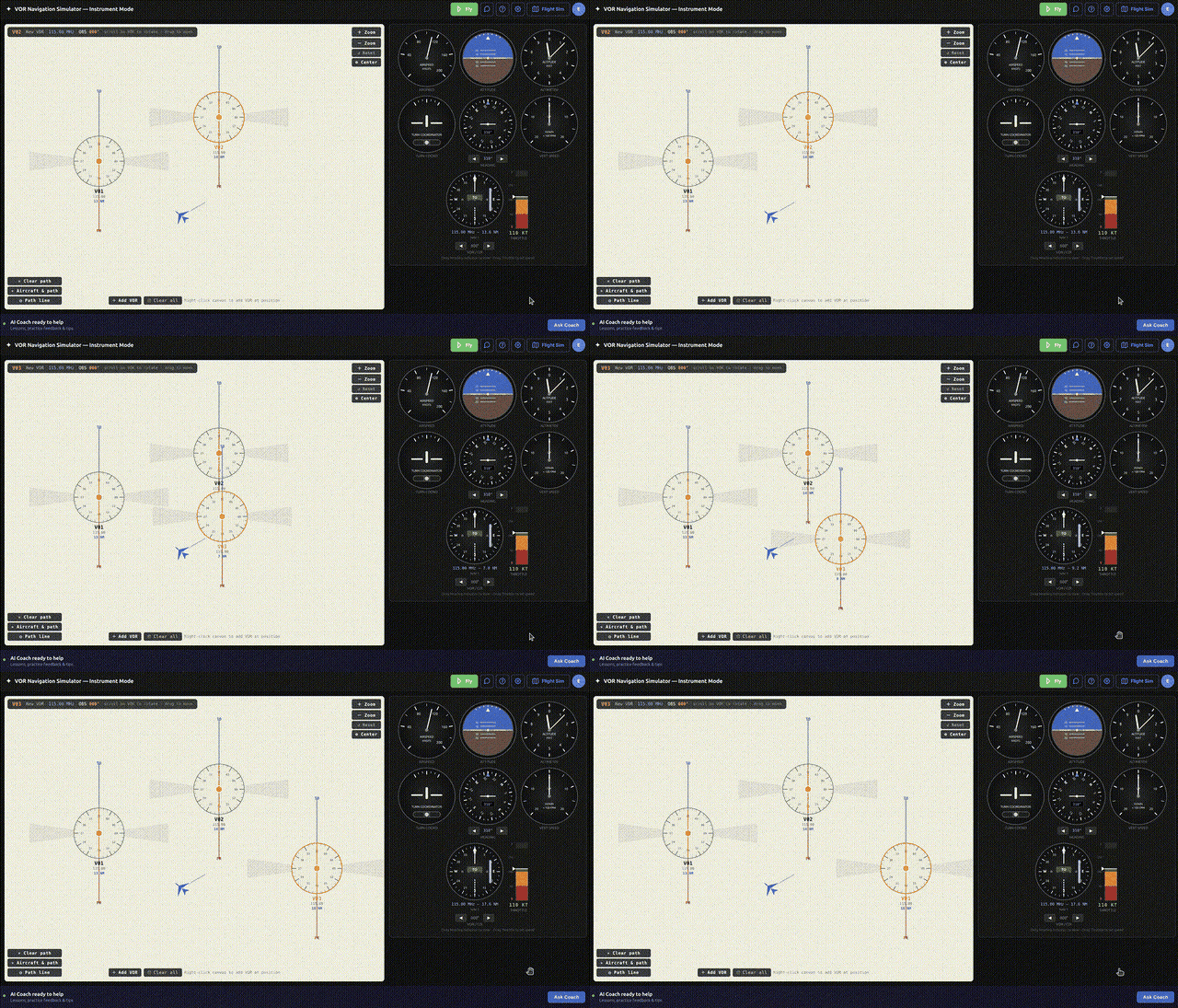
If you are a student pilot watching Artemis II unfold, recognize what you are seeing: the direct application of the navigation principles, manual flying skills, and systems thinking that you are learning right now. The radial you track in a VOR simulator is built on the same physics that guides Orion through cislunar space. The instrument scan you practice in a training aircraft is the same discipline that keeps four astronauts oriented 240,000 miles from home.
Artemis II is not just a space mission. It is a statement that human skill, precision, and judgment still matter in an age of extraordinary automation. That statement applies at Flight Level 350, at pattern altitude, and at the Moon. The best time to start building those skills is now.