Why ATC Phraseology Matters

Ask any student pilot what intimidates them most about learning to fly, and the answer is almost always the same: talking on the radio. The idea of keying the mic and speaking to an aviation controller — knowing that every pilot on the frequency is listening — is enough to make even confident people freeze.
But ATC communication is not improvised conversation. It is a standardized system of phraseology designed to eliminate ambiguity, reduce errors, and keep aircraft separated. Once you learn the structure, radio calls become as routine as a preflight checklist. The key is understanding the system before you key the mic.
Whether you are requesting flight following, reading back a clearance, or simply reporting your position, every word you say on the radio follows a pattern that aviation controllers expect. Mastering that pattern is one of the most important parts of your pilot study.
The ICAO Phonetic Alphabet: From Alpha to Zulu
The foundation of all ATC communication is the ICAO phonetic alphabet — also known as the NATO phonetic alphabet. Adopted internationally on March 1, 1956, this system assigns a unique code word to each letter of the English alphabet: Alpha, Bravo, Charlie, Delta, Echo, Foxtrot, Golf, Hotel, India, Juliett, Kilo, Lima, Mike, November, Oscar, Papa, Quebec, Romeo, Sierra, Tango, Uniform, Victor, Whiskey, X-ray, Yankee, and Zulu.
Every pilot and aviation controller uses these words when spelling out callsigns, taxiway identifiers, runway designations, and navigation fixes. When a controller tells you to "taxi to Runway Two-Seven via Alpha, Echo, Foxtrot," those are not random words — they are specific taxiway identifiers that correspond to markings on the airport surface.
The phonetic alphabet exists because letters that sound similar — B and D, M and N, E and T — are nearly indistinguishable over a noisy radio frequency. "Echo" is unmistakable. "E" is not. This simple system has prevented countless miscommunications since its adoption nearly 70 years ago.
Anatomy of a Radio Call
Every radio transmission in aviation follows the same basic structure: who you are calling, who you are, where you are, and what you want. Student pilots who memorize this structure find that radio communication becomes dramatically less intimidating.
For example, a typical initial contact with an approach controller sounds like this: "Tampa Approach, Cessna One-Seven-Two-Echo-Charlie, ten miles north of Lakeland at three thousand five hundred, request flight following to Orlando Executive." That single sentence tells the controller everything they need: the facility you are calling, your callsign (using the phonetic alphabet), your position, altitude, and request.
The controller's response will follow the same disciplined structure. They might reply: "Cessna Two-Echo-Charlie, Tampa Approach, squawk four-two-one-seven, altimeter three-zero-zero-two." Your readback confirms the critical elements: "Squawk four-two-one-seven, altimeter three-zero-zero-two, Cessna Two-Echo-Charlie."
Notice the pattern: the controller abbreviates your callsign after initial contact, numbers are spoken individually (four-two-one-seven, not four thousand two hundred seventeen), and the readback includes the callsign at the end. These are not suggestions — they are standardized procedures that every aviation controller expects.
Critical Phrases Every Pilot Must Know
Beyond the phonetic alphabet, there are specific phrases that carry precise operational meaning. Confusing them can have serious consequences:
"Cleared" means you have authorization to do something — cleared for takeoff, cleared to land, cleared the ILS approach. This word is reserved exclusively for ATC clearances. Pilots should never use the word "cleared" in a readback unless they are confirming a clearance.
"Hold short" means stop before reaching a specific point — usually a runway. A hold-short instruction is a safety-critical command. You must read it back verbatim: "Hold short Runway Two-Seven, Cessna Two-Echo-Charlie." If you miss this readback, the controller will repeat the instruction.
"Unable" is your right as pilot-in-command. If a controller gives you an instruction that you cannot safely comply with — a turn into weather, an altitude you cannot reach, a runway you cannot make — the correct response is "unable." The controller will provide an alternative.
"Say again" means repeat your last transmission. Never say "repeat" on an aviation frequency — in military communications, "repeat" means to fire again, and the habit of avoiding it carries over to civilian aviation.
"Wilco" means "I will comply." It replaces a full readback when the instruction does not contain critical numbers like altitudes, headings, or frequencies. But when in doubt, read it back — controllers appreciate precision over brevity.
Common Mistakes Student Pilots Make on the Radio
The most common radio mistake is not a wrong word — it is keying the mic without knowing what you are going to say. Dead air, filler words ("uhhh"), and rambling transmissions clog the frequency and frustrate controllers who are managing dozens of aircraft.
Before you transmit, think WWWW: Who am I calling? Who am I? Where am I? What do I want? If you can answer those four questions in your head before you press the button, your transmission will be clean and professional.
Another frequent mistake is reading back non-critical information while omitting the critical parts. If a controller says "Cessna Two-Echo-Charlie, turn left heading one-eight-zero, descend and maintain three thousand," your readback must include the heading and altitude: "Left heading one-eight-zero, descend three thousand, Cessna Two-Echo-Charlie." Saying "roger" alone is not sufficient for instructions containing specific numbers.
Finally, student pilots often speak too fast. Controllers are trained to process standardized phraseology at a moderate pace. Speaking slowly and clearly — especially when giving your callsign — makes the controller's job easier and reduces the chance of a miscommunication that could compromise safety.
Building Radio Confidence Through Practice
ATC communication is a skill, and like all skills, it improves with deliberate practice. Listening to LiveATC.net, where you can hear real controllers and pilots communicating at airports around the world, is one of the best free resources for pilot study. Pick an airport you plan to fly into, listen to the ground and tower frequencies, and practice scripting your own calls as if you were in the pattern.
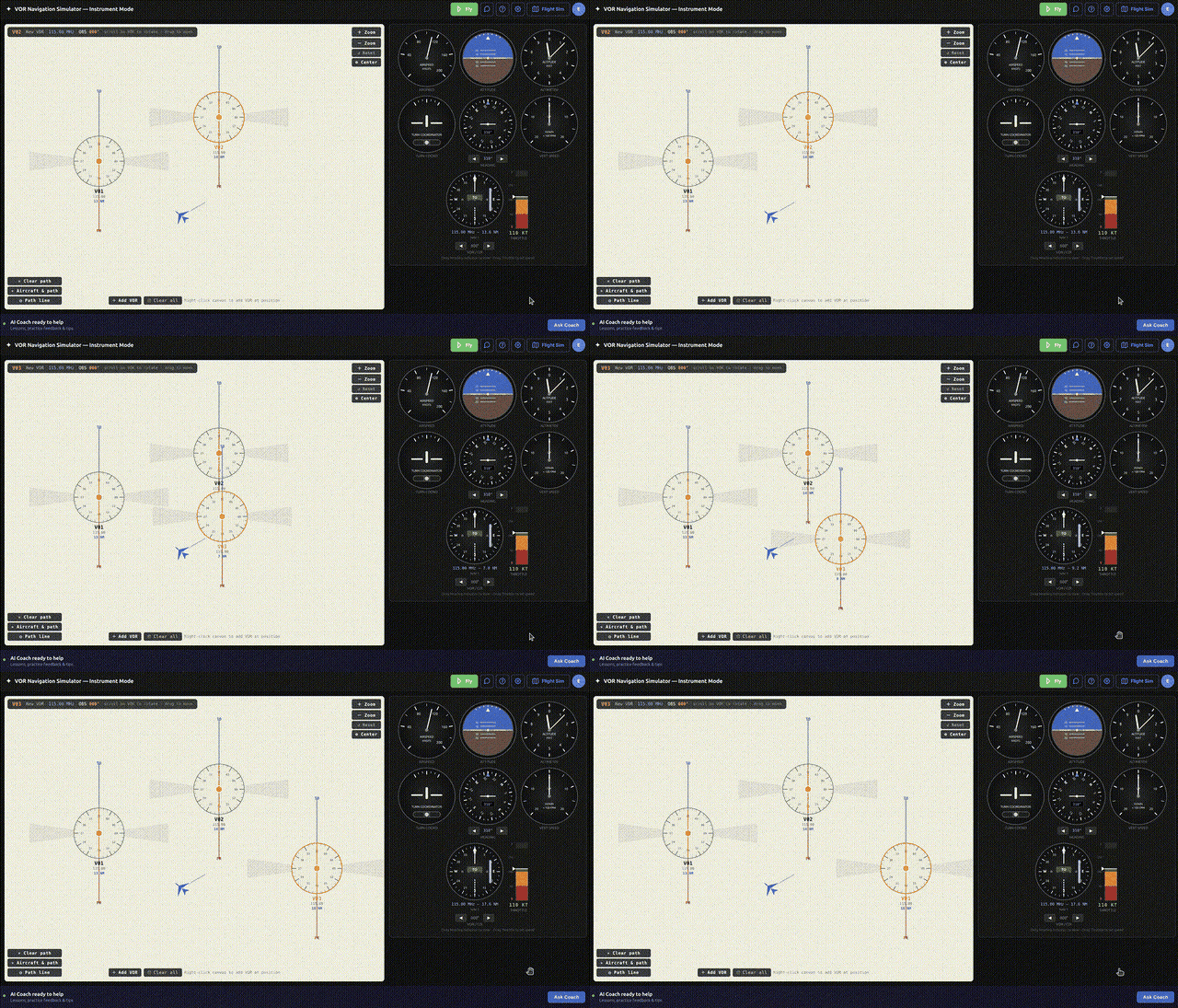
Simulator training adds another dimension. Practicing navigation procedures — tracking VOR radials, intercepting courses, managing CDI deflection — while simultaneously making position reports builds the multitasking muscle that every pilot needs. The goal is to make radio communication automatic so you can focus your mental bandwidth on flying the aircraft.
The aviation controller on the other end of the frequency is not your adversary — they are your partner in safety. The more fluent you become in their language, the more effective that partnership becomes. Start with the phonetic alphabet, learn the standard phrases, practice before you fly, and you will find that the radio is not the scariest part of aviation — it is one of the most rewarding.