Flight Sim Is No Longer Just a Game
A decade ago, telling your flight instructor that you practiced in a flight sim might have earned a polite smile and a suggestion to focus on real stick time. That era is over. In 2026, flight simulator training is recognized by the FAA, endorsed by flight schools, and used by airlines worldwide to train, evaluate, and certify professional pilots.
The global flight simulator market — valued at $6.8 billion in 2022 — is projected to reach $11.6 billion by 2030. That growth is not driven by gamers. It is driven by airlines that need cost-effective training solutions, flight schools that need to scale, and student pilots who have discovered that quality sim time directly translates to better performance in the real cockpit.
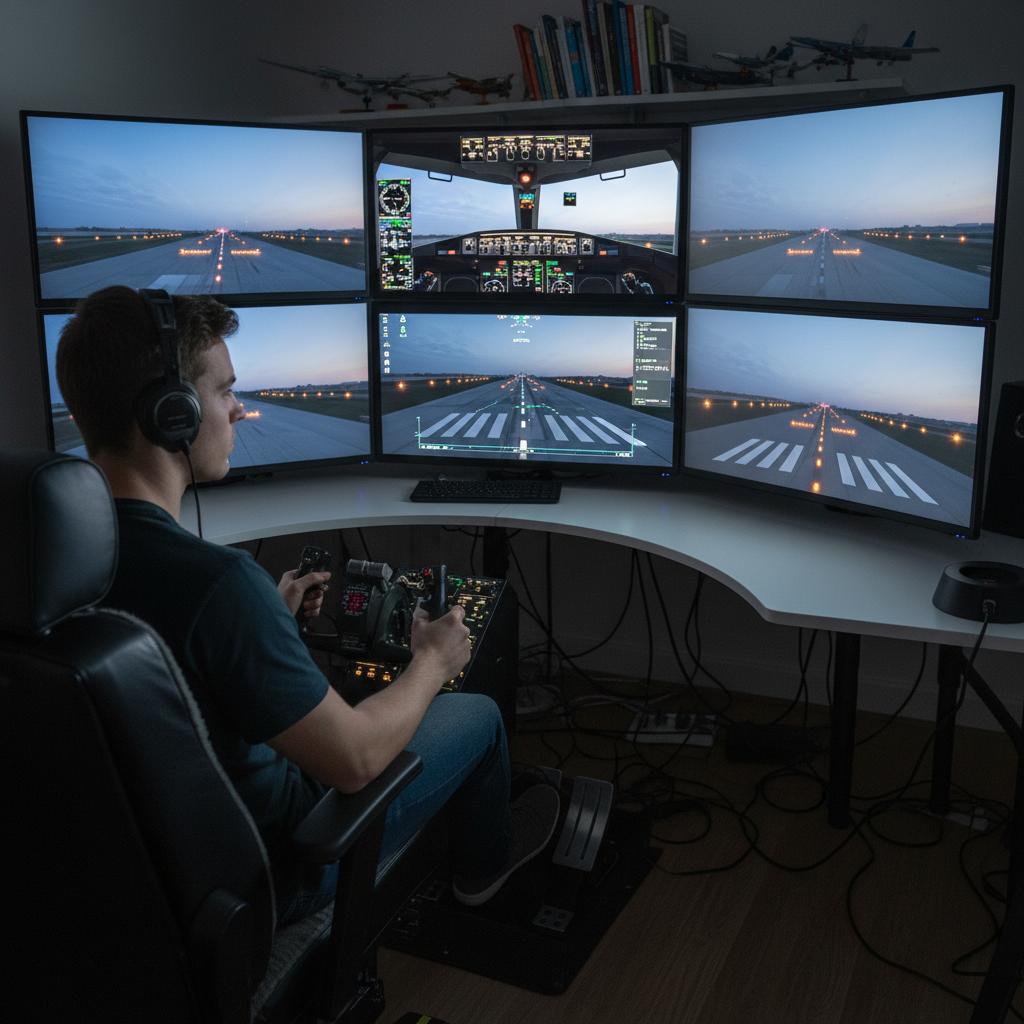
Whether you are practicing VOR navigation on a web-based trainer, running instrument approaches on Microsoft Flight Simulator, or logging time in an FAA-approved Advanced Aviation Training Device, simulator training is now a core part of the flight training pipeline — not a supplement to it.
What Transfers from Sim to Cockpit
Not everything in a flight sim translates directly to real flying. You will not learn how a Cessna feels in turbulence from a desktop setup, and no amount of sim time replaces the spatial awareness that comes from looking out a real window. But the skills that do transfer are exactly the ones that student pilots struggle with most.
Instrument scan. The ability to rapidly cross-check your airspeed, altitude, heading, and vertical speed indicators is a learned rhythm. Flight sims let you practice this scan thousands of times before your first real instrument lesson, building the eye movement pattern that experienced pilots rely on instinctively.
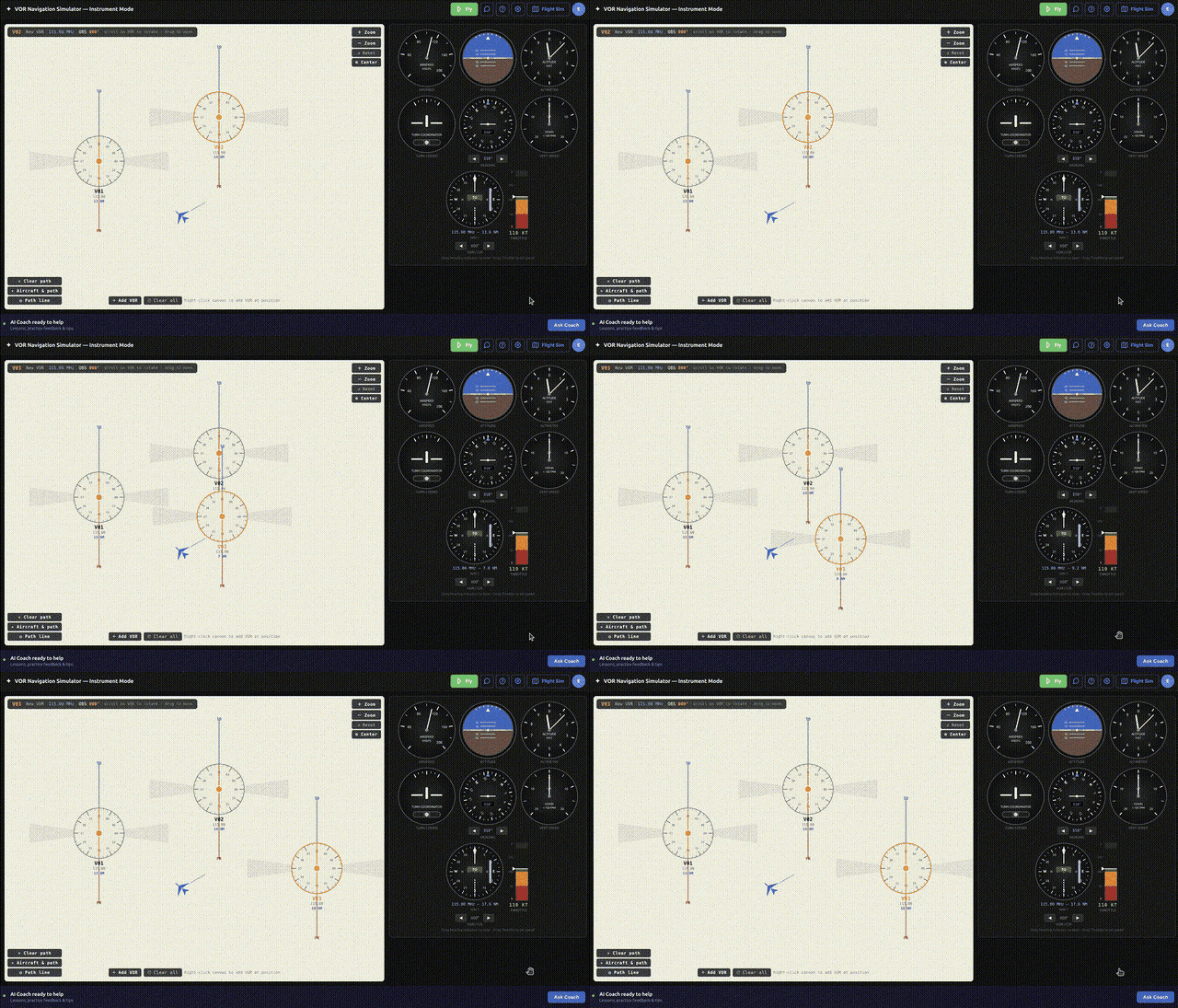
Navigation procedures. Tracking a VOR radial, intercepting an inbound course, identifying station passage, and interpreting CDI deflection are all cognitive skills that translate perfectly from sim to cockpit. The physics are the same, the instruments behave the same, and the mental model you build in the sim is the same one you will use at 5,000 feet.
Checklist discipline. Using proper flows and checklists in the sim builds the habit of systematic cockpit management. Pilots who rush through checklists in the sim rush through them in the airplane. Pilots who are methodical in the sim carry that discipline into the real cockpit.
Radio communication patterns. Many modern flight sims include AI-powered ATC that responds to standard phraseology. Practicing radio calls — even to a simulated aviation controller — reduces the anxiety of talking on a real frequency for the first time.
How the FAA Views Simulator Time
The FAA recognizes simulator training through a tiered system of training devices. At the top are Full Flight Simulators (Level A through D) used by airlines — these can replicate everything from engine failures to wind shear with physical motion. At the entry level are Basic Aviation Training Devices (BATDs) and Advanced Aviation Training Devices (AATDs), which are common in flight schools.
Under 14 CFR Part 61, student pilots can log up to 2.5 hours of instrument training time in a BATD toward the private pilot certificate. For the instrument rating, up to 20 hours can be logged in an AATD. Part 141 programs allow even more simulator credit, depending on the approved training curriculum.
Desktop flight sims like Microsoft Flight Simulator and X-Plane are not FAA-approved for logging time. But that does not mean they are useless — far from it. The cognitive benefits of home sim practice are well documented, and many flight instructors now recommend sim sessions between lessons as a way to reinforce procedures without the $200-per-hour cost of aircraft rental.
Building a Productive Sim Practice Routine
The difference between productive sim training and aimless sim flying is structure. A student pilot who spends 30 minutes practicing a specific VOR intercept procedure will learn more than one who spends two hours sightseeing over virtual mountains.
Start each sim session with a specific objective. Today you are going to practice tracking the 270 radial inbound to a VOR. Or you are going to fly a full ILS approach from initial contact to missed approach. Or you are going to practice three patterns of steep turns while holding altitude within 100 feet. One objective, one session.
Debrief yourself. After each session, note what went well and what did not. Did your CDI stay centered during the VOR approach? Did you maintain altitude on the base turn? Did you remember to switch frequencies at the right time? This self-assessment habit is one of the most valuable skills you can develop as a student pilot — and it starts in the sim.
Use the sim to preview real flights. Before flying to a new airport, set up the sim with the same departure, route, and arrival. Practice the radio calls, study the taxiways, and fly the approach. When you do it for real, the environment will already feel familiar — reducing workload and freeing mental bandwidth for the unexpected.
The Future of Sim-Based Flight Training
The integration of artificial intelligence into flight simulators is accelerating. Tools like SimInstructor.AI provide real-time voice coaching during sim sessions — calling out deviations, prompting checklists, and debriefing performance automatically. Sporty's ChatCFI acts as an always-available ground school instructor, answering questions and generating personalized study guides.
Web-based VOR trainers let student pilots practice navigation fundamentals without installing any software — building the spatial reasoning skills that underpin all instrument flying. These tools are particularly valuable for early-stage pilot study, where the goal is to understand concepts like radial identification, course interception, and CDI interpretation before encountering them in a moving aircraft.
The aviation news is clear: simulator training is no longer optional for serious student pilots. It is the most cost-effective, accessible, and scalable way to build the skills that make the difference between a pilot who is prepared and one who is catching up. Every hour you invest in structured sim practice is an hour that pays dividends in the real cockpit.