Can You Practice ATC Communication for Free?
Yes. You can practice ATC communication for free without a radio, an aircraft or a paid course. Between free listening feeds, the FAA's own phraseology guide, flight simulator networks and browser-based ATC simulators, there are more ways to rehearse radio calls than most student pilots realize.
They do not all train the same skill, though. Listening teaches you what the radio sounds like. Reading teaches you the correct words. Only speaking, and getting a response, teaches you to produce a clean call while someone is waiting for it. A good free practice routine uses all three, so here are five options and what each one is actually good for.
Practice Your Radio Calls Before You Key the Mic
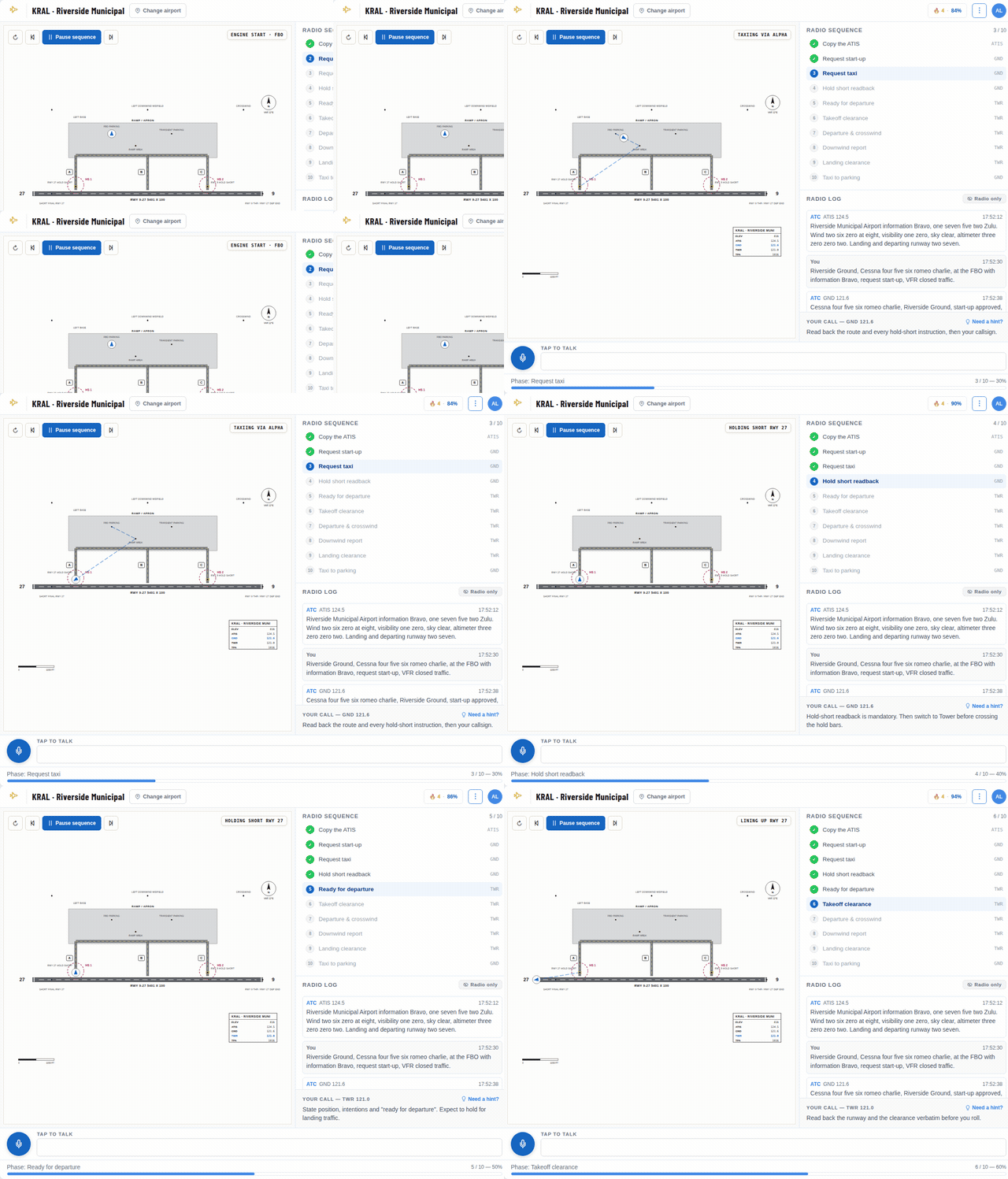
Talk to an AI controller at a real airport, out loud or by typing, and get scored on your phraseology. It runs right in your browser.
The first lessons are free. A hint is one click away whenever you get stuck.
1. Listen to Real Controllers on LiveATC
LiveATC.net streams radio traffic from airports around the world, and you can listen on its website at no cost. It is the easiest place to start, because it gets your ear used to the speed and rhythm of a real frequency.
Passive listening fades quickly, so give yourself a job. Pick a towered airport near where you train, pull up its airport diagram, and follow one aircraft from first call to takeoff. Then try to say each pilot's readback before they do. AOPA's guide for new pilots makes the same point: imitating what you hear on the radio is often how phraseology gets learned, so choose good examples to copy.
The limit: nobody answers you. LiveATC builds comprehension, but it will not tell you whether your own call was any good.
2. Learn the Words from the FAA AIM
The Aeronautical Information Manual is free on the FAA website, and Chapter 4, Section 2 (Radio Communications Phraseology and Techniques) is the reference to read. It is shorter than its reputation suggests. It states that the single most important thought in pilot-controller communications is understanding, and it covers initial contacts, call signs and the habit of listening before you transmit.
The Pilot/Controller Glossary, also free from the FAA, settles the definitions of terms you will hear on frequency. If you are unsure of the difference between "hold short" and "line up and wait", that is where to check.
The limit: knowing the correct wording on paper is very different from producing it under time pressure. Treat the AIM as your source of truth, then go and say the words out loud.
3. Chair Fly Your Calls Out Loud
Chair flying needs nothing but a quiet room and a written script. Sit down with the diagram of your home airport, imagine the flight, and speak every call at full voice, in order, from the ATIS to parking. Saying the words silently in your head does not count, because the hesitation only shows up when you use your actual voice.
A simple framework helps. Almost every first call answers the same four questions: who you are calling, who you are, where you are and what you want. "Riverside Ground, Cessna four five six Romeo Charlie, at the ramp with information Alpha, request taxi for departure." Our step-by-step guide on how to talk to ATC walks through each call in a typical flight if you want a full script to rehearse.
The limit: you have to play both sides. You will always know what the controller is about to say, and you are the one judging your own performance. Ask your instructor to play the controller for ten minutes before a lesson, because it is one of the cheapest upgrades available.
4. Fly on VATSIM with Volunteer Controllers
VATSIM is a free online network that connects flight simulator pilots with volunteer human air traffic controllers. Membership and the pilot software cost nothing, and talking to a real person who is giving you real instructions is excellent practice.
The catch is the setup. You need a flight simulator that you pay for separately, a Windows PC for the usual pilot clients, and enough comfort with the simulator to fly and talk at the same time. Controller coverage also depends on who is online at that moment, so your home airport may not be staffed when you log on. VATSIM procedures and real-world practice can also differ in the details, so check anything unfamiliar against the AIM or with your instructor.
It is a strong option if you already own a simulator, and a lot of setup if all you want is to rehearse a taxi call tonight.
5. Use a Free ATC Simulator in Your Browser
The newest option is an AI-based ATC simulator: you make the call, software plays the controller, and you get feedback on what you said. This closes the gap the other methods leave open, because you speak, something responds, and you find out what you missed without needing a person on the other end.
This is what we built the RadialCoach ATC simulator to do, and seven of its lessons are free with a free account. You fly at Riverside Municipal (KRAL), a Class D airport in California, on a diagram drawn from the real layout. The free lessons start with copying the ATIS, contacting Ground and calling Tower ready for takeoff, then build up to a full flight from ATIS to parking and a Mayday call for an engine failure on downwind. Nothing needs installing, and it runs at radialcoach.com/atc.
You can speak into your microphone or type if you are not ready to talk yet. An AI controller answers in a radio voice, each call is scored on the elements a controller expects to hear, and the debrief shows what was missing. Voice use on the free plan has a daily limit, and more airports and lessons are part of the paid plan.
The limit: a simulator is a rehearsal, not a substitute for instruction or real frequency time. Its value is that you arrive at the aircraft having already made these calls many times. Other apps offer free tiers too, so it is worth trying a few to see which suits you. Check what is really included, as some give you only a handful of free sessions.
A Free 20-Minute ATC Practice Routine
Five minutes of listening: follow one aircraft at a towered airport on LiveATC, with the airport diagram open.
Five minutes of reading: pick one call you find hard, such as a hold-short readback, and check the correct wording in the AIM.
Five minutes of chair flying: say that call out loud ten times, then run it as part of the full sequence.
Five minutes of simulated calls: make the same call to a simulator or your instructor, and note what you left out.
Short daily sessions tend to work better than one long weekend cram, because the goal is for the format to become automatic. Once it is, your attention is free for the part that changes on every flight: the runway, the route and the traffic.
Common Mistakes When Practicing Radio Calls
Only ever listening. Comprehension improves, but the first time you speak will still feel like the first time. Speak out loud in every session.
Rushing. Fast is not the same as good. The AIM's emphasis is on understanding, so a clear, slightly slower call beats a hurried one that gets a "say again".
Abbreviating your call sign on first contact. The AIM says call signs should never be abbreviated on an initial contact, or when other aircraft have similar-sounding call signs.
Skipping the readback practice. Runway assignments and hold-short instructions are the calls that matter most, so give them more repetitions than the easy ones.
Forgetting that you can ask for help. If you are a student pilot, say so on initial contact. AOPA notes that controllers understand students are learning and will gladly give extra assistance when you identify yourself. "Say again" is always acceptable too.
Which Free ATC Practice Should You Start With?
If you have not started flight training, begin with LiveATC and a free simulator lesson, which together will show you whether the radio is as intimidating as it looks. If you are a student pilot with a first towered-airport lesson coming up, focus on chair flying and simulated calls using your own airport's procedures. If you already own a flight simulator and have the basics, VATSIM is a great next step.
Whichever you choose, the rule is the same: say the words out loud, and get something or someone to answer back. Radio confidence comes from repetitions, and none of the options above requires paying for hours in the aircraft to get them. Your instructor remains the final word on what is correct for your airport and your training.