What Happened Over Palm Beach County
On Sunday, November 1, 2026, a Learjet 60 business jet, registration N722BD, crashed in the Greenacres area of Palm Beach County, Florida, at about 12:50 p.m. local time. The private flight had departed Austin-Bergstrom International Airport in Texas and was bound for North Eleuthera in the Bahamas. U.S. Transportation Secretary Sean Duffy confirmed that all nine people on board were killed.
According to reporting on air traffic control recordings and flight tracking data, the jet was cruising eastbound at 35,000 feet when the crew reported turbulence, light clear ice and precipitation, and asked to climb 2,000 feet. Shortly afterwards the aircraft entered a steep dive. The FAA said it descended from about 35,250 feet to 8,750 feet in roughly one minute, with descent rates reported above 30,000 feet per minute. A pilot declared a mayday and described an overspeed condition before the jet struck the ground almost vertically near Military Trail.
The impact left a crater close to homes and a busy road. About 600 residents of a nearby mobile home community were evacuated, and Florida Governor Ron DeSantis said there were no immediate reports of injuries on the ground. The NTSB has opened an investigation with FAA support. No cause has been determined, and nothing in this article should be read as one.
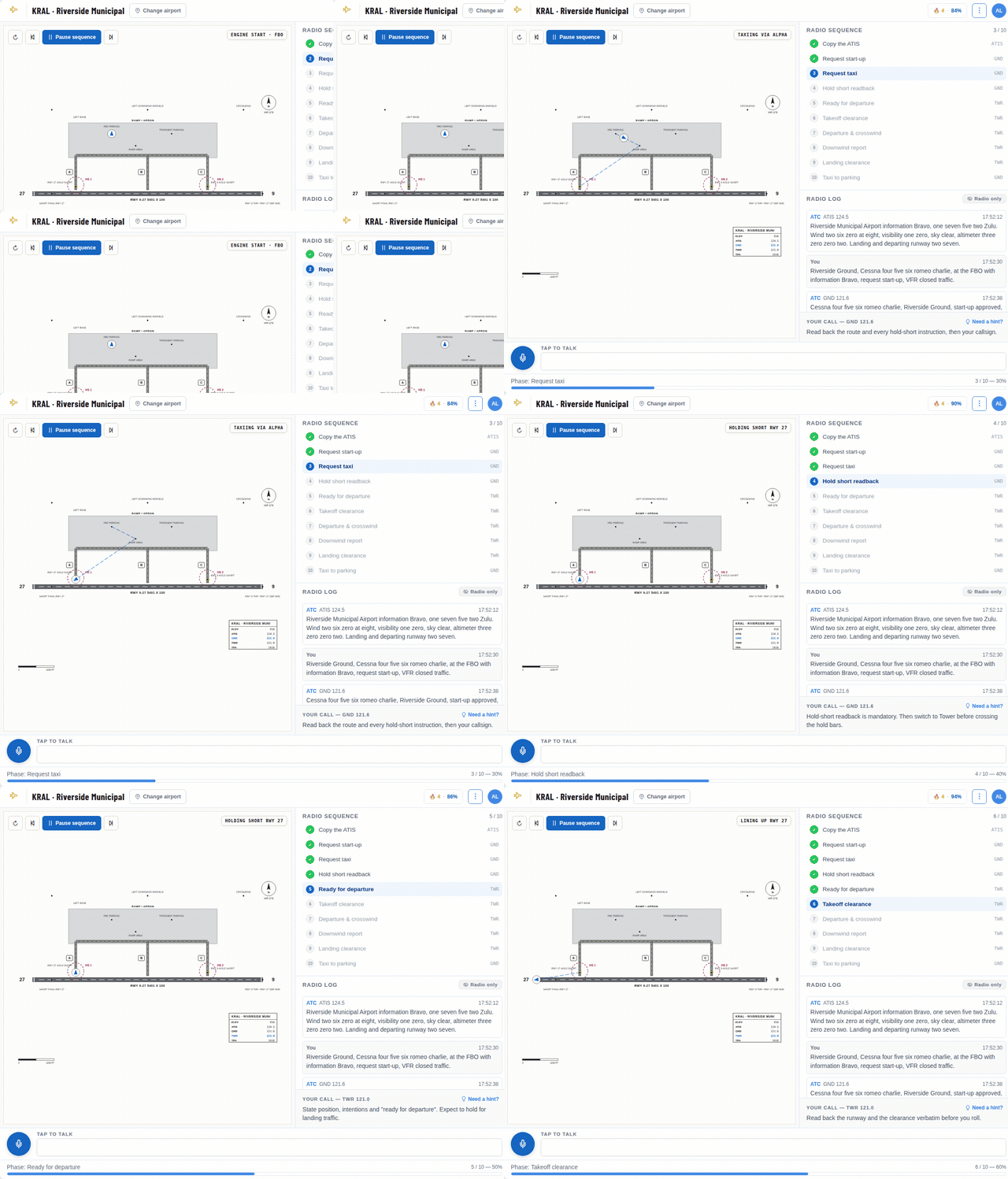
Practice Your Radio Calls Before You Key the Mic
Talk to an AI controller at a real airport, out loud or by typing, and get scored on your phraseology. It runs right in your browser.
The first lessons are free. A hint is one click away whenever you get stuck.
The Weather Picture: Convection at Cruise Altitude
Rain and thunderstorms covered South Florida that afternoon, and the National Weather Service had a flood watch in effect. Reports indicate the jet passed through a strong storm cell minutes before the descent began, with an outside air temperature of about -47°C at cruise.
For student pilots, the important idea is that a thunderstorm is not just a low-altitude hazard. Mature convective cells in Florida can tower well above 40,000 feet. Inside and around them you can find severe turbulence, strong updrafts and downdrafts, hail, and icing, sometimes in combination. The FAA's Aviation Weather Handbook (FAA-H-8083-28) and Advisory Circular AC 00-24, Thunderstorms, both stress the same rule: avoid severe or embedded storms by a wide margin rather than trying to fly through them.
High-altitude icing is often underestimated because the air is so cold. But strong convection can carry large amounts of supercooled water and ice crystals very high. Ice crystals can affect air data probes and engines, and a disturbed airspeed indication is one of the hardest things a crew can face when the margins are already thin.
Why High Altitude Leaves Little Margin
At high cruise altitudes, a jet flies in a narrow band between its stall speed and its maximum operating speed, sometimes called the "coffin corner". Turbulence that pitches the nose or changes the airspeed by a few knots can push the aircraft toward either edge. Reports say turbulence jolted this jet by as much as 700 feet before the dive, which shows how violent the air was.
Once a jet starts down steeply, airspeed builds quickly. An overspeed, like the one the crew reportedly described, can make recovery harder because control forces change and structural limits come into play. Aviation commentators have noted that the Learjet tends to accelerate rapidly when control is lost at altitude. Whether that played any part here is for the NTSB to determine, likely after a long investigation that will look at weather data, ATC logs, wreckage and maintenance records.
Lessons for Student Pilots
You are probably flying a trainer at 3,000 feet, not a jet at FL350. The lessons still apply, because the decisions that keep you away from a storm are made long before you meet it.
First, treat thunderstorms as no-go zones. A common guideline from AC 00-24 is to stay at least 20 nautical miles from severe thunderstorms and to never fly under an anvil or between closely spaced cells. In a light aircraft without onboard radar, the safest storm is one you planned around on the ground.
Second, brief the weather properly. Look at convective SIGMETs, the Graphical Forecasts for Aviation, and the radar trend, not just the current picture. Florida afternoons can change in an hour. If the forecast shows building convection along your route, a later departure or a different route is a good decision, not a weak one.
Third, ask ATC for help early. Controllers can often see weather on their displays and suggest deviations. Phrases like "requesting deviation 20 degrees left for weather" or "request vectors around the cell ahead" are normal and expected. The earlier you ask, the more options you have.
Fourth, know how to declare an emergency. "Mayday, mayday, mayday", followed by your call sign, your problem and your intentions, gets you priority immediately. Under 14 CFR 91.3, the pilot in command may deviate from any rule to meet an emergency. Many pilots wait too long to say the word. Practise it so it comes out naturally.
Finally, learn basic upset recognition and recovery. The FAA's Airplane Flying Handbook covers it, and many instructors now include upset prevention in primary training. The core habit is simple: recognise an unusual attitude early, reduce or manage power, unload to reduce angle of attack, roll wings level, and then recover pitch smoothly.
Where Simulation Fits
A browser simulator cannot teach you how severe turbulence feels, and it is not a substitute for upset training with a qualified instructor. What it can do is build the habits that keep your workload low when the weather gets busy: knowing where you are, knowing which way to turn, and knowing what to say on the radio.
In RadialCoach you can practise orienting on a VOR radial quickly, so a deviation for weather does not leave you lost. Our ATC simulator lets you practise radio calls out loud with a controller that answers back. A few minutes of rehearsal on the ground makes those words easier to find when you really need them.
Remembering the Nine on Board
Nine people lost their lives on November 1, and our thoughts are with their families and friends, and with the Greenacres community whose neighbourhood was affected. We are also grateful to the first responders who worked the scene.
The NTSB will publish a preliminary report in the coming weeks and a final report later. Until then, the best way to honour those lost is to avoid speculation, follow the facts as they are released, and take the general lessons about weather and decision-making into our own flying.