The Short Answer
Squawk 7700 means an aircraft has declared a general emergency. "Squawk" is radio shorthand for the four-digit code set in the transponder, the box that replies to radar and tells controllers who you are and how high you are. Three codes are reserved for trouble: 7700 for an emergency, 7600 for a radio failure and 7500 for unlawful interference, such as a hijacking.
The code does not say what is wrong. A 7700 can mean an engine failure, a fire, a hydraulic fault, a landing gear that will not retract or a seriously ill passenger. The details come over the radio, which is why the transponder code and the Mayday call belong together.
Searches for "squawk 7700" jump every time a flight-tracking site shows an airliner squawking it. This guide explains what each emergency code means, what happened in two recent cases, and what a student pilot should do if they ever need one.
Practice Your Radio Calls Before You Key the Mic
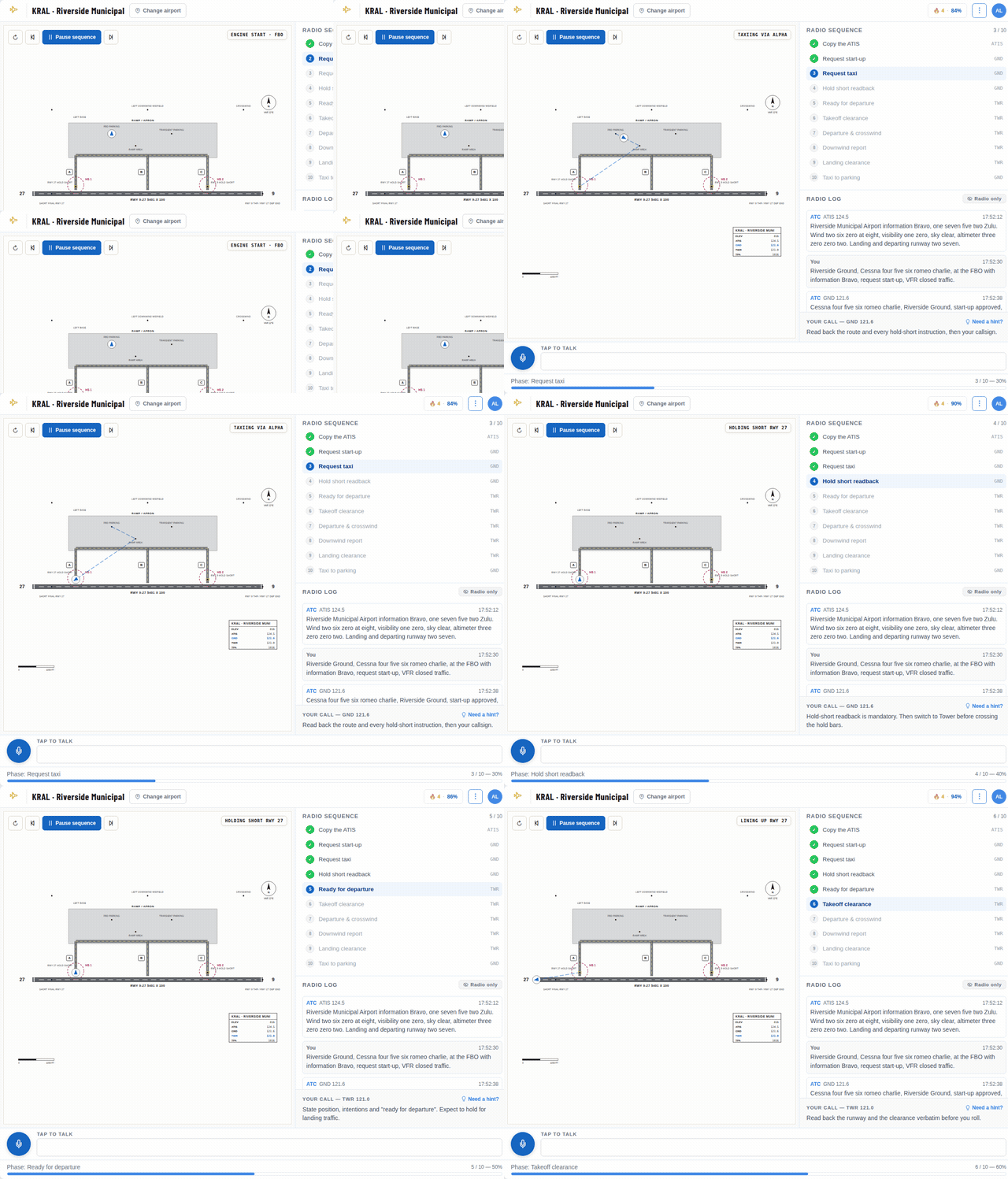
Talk to an AI controller at a real airport, out loud or by typing, and get scored on your phraseology. It runs right in your browser.
The first lessons are free. A hint is one click away whenever you get stuck.
Squawk 7700: General Emergency
The FAA's Aeronautical Information Manual covers this in AIM 6-2-2. When a distress or urgency condition comes up, a pilot who wants to alert a ground radar facility should squawk 7700 with altitude reporting (Mode C) and then immediately establish communications with ATC. Radar facilities are equipped so that 7700 normally triggers an alarm or special indicator at all control positions.
The AIM adds a detail many pilots miss. You might not be inside radar coverage, so keep squawking 7700 and get on the radio as soon as possible. The code is a flare, not a conversation.
There is one more nuance, in AIM 6-3-2. If you are already talking to a controller, the guidance is to keep the code you were assigned, unless told otherwise, and declare the emergency by voice. Squawk 7700 when you cannot immediately reach anyone. In plain terms: if a controller is already watching you, tell them; if nobody is, set 7700 and start calling.
Squawk 7600: Lost Communications
If you lose two-way radio, AIM 6-4-2 says to set the transponder to 7600. Again, you may not be in radar coverage, so the code alone does not guarantee anyone has seen you.
What you do next depends on how you are flying. For IFR flights, AIM 6-4-1 quotes 14 CFR 91.185: if the failure happens in VFR conditions, or you find VFR conditions afterward, continue under VFR and land as soon as practicable. The same rule spells out the route and altitude to fly if you stay in instrument conditions.
For a VFR student, most radio failures are not failures at all. Before squawking 7600, check the volume and squelch, the headset plugs, the push-to-talk switch, the audio panel and the frequency you dialed. AIM 6-4-3 also suggests trying the previously assigned frequency. If the radio really is dead and you need to land at a towered airport, the tower can still talk to you with light gun signals.
Squawk 7500: Unlawful Interference
Code 7500 means the aircraft is being hijacked or forced to a new destination. AIM 6-3-4 is unusually blunt about it: ATC will never assign 7500 without prior notification from the pilot that the aircraft is under unlawful interference, and a pilot should refuse a 7500 assignment in any other situation and tell the controller. Like the other two codes, it triggers a special emergency indicator in all radar ATC facilities.
Many pilots remember the three codes with an old rhyme: seven-five, a man with a knife; seven-six, the radio needs a fix; seven-seven, going to heaven. The last line is darker than reality. Most 7700 squawks end with a normal landing.
Do Not Squawk an Emergency by Accident
Because these codes set off alarms, AIM 4-1-20 asks pilots to avoid selecting 7500, 7600 or 7700 by accident during routine code changes. Its own example: to change from 2700 to 7200, turn the first knob to get 2200 and then 7200, never passing through 7700 on the way.
When you are not talking to anyone, the standard VFR code in the United States is 1200 (also in AIM 4-1-20). In much of Europe the VFR conspicuity code is 7000, so check the local rules before you fly abroad.
Two Recent Squawk 7700 Cases
On 1 October 2026, Emirates flight EK31, an Airbus A380 flying from Dubai to London Heathrow, squawked 7700 at cruise and diverted to Frankfurt. Flightradar24 showed the aircraft squawking 7700 and descending near Frankfurt. Emirates confirmed the diversion was for a medical emergency involving a passenger. The aircraft landed safely, the passenger was taken off for medical care, and the flight continued to Heathrow after about two hours on the ground.
On 21 August 2026, a Thai Airways Boeing 777-300ER operating TG921 from Frankfurt to Bangkok turned back shortly after takeoff when its left main landing gear would not retract. The crew declared an emergency, dumped fuel to reduce landing weight and landed safely back in Frankfurt. No injuries were reported.
Neither event was a disaster, and that is the point. A 7700 squawk tells everyone on the ground to clear the way and get ready to help. Crews use it for a sick passenger as readily as for a mechanical fault, and controllers respond the same way: priority handling, fewer questions, and equipment waiting at the runway.
What Student Pilots Should Take From This
Declare early. Under 14 CFR 91.3(b), the pilot in command in an in-flight emergency may deviate from any rule to the extent required to meet that emergency. Asking for help costs you nothing. Waiting until you are out of options costs you time, altitude and choices.
Aviate, navigate, communicate, in that order. Fly the airplane first. The squawk and the call come once the airplane is under control, and they should take seconds, not minutes.
Know the call before you need it. AIM 6-3-2 lists the elements of a distress message, preferably in this order: "Mayday" three times (or "Pan-pan" three times for an urgency), the station addressed, your aircraft identification and type, the nature of the emergency, weather, your intentions and request, position and heading, altitude, fuel remaining in minutes, number of people on board, and any other useful information. You will not say all of it in a real emergency. The first few items, said clearly, do most of the work.
Expect questions. Once you declare, the controller will often ask for souls on board and fuel remaining. Answer briefly and keep flying. Under stress, short and correct beats complete.
Practice the Mayday Before You Ever Need It
Emergency calls are the radio calls students practice least, because nobody wants to rehearse them in a real airplane on a busy frequency. That is exactly why they deserve practice somewhere safe. Saying "Mayday, Mayday, Mayday" out loud for the first time should not happen with a dead engine.
The RadialCoach ATC simulator has a free emergency lesson built around this moment. The engine quits abeam midfield on left downwind at Riverside Municipal (KRAL). You declare the emergency with a correct Mayday call, answer Tower's souls-on-board and fuel-remaining questions while you glide, and report down and safe. You speak into your microphone, an AI controller answers in a radio voice, and every call is scored on what you included and what you left out. It runs in the browser at radialcoach.com/atc and needs only a free account.
Four Digits Worth Knowing Cold
Behind every 7700 on a flight tracker there is a crew working a problem and a controller clearing the sky for them. Most of those stories end quietly on a runway with fire trucks that were not needed. Learn the three codes, learn the order of the distress call, and practice saying it, so that if your day ever comes, the radio is the easy part.