The Short Answer
Air traffic control is the service that keeps aircraft apart and keeps traffic moving, on the ground and in the air. In the United States it is run by the FAA. According to the FAA's Air Traffic By the Numbers page, it handles an average of 44,360 flights a day, with more than 14,000 controllers and 527 airport traffic control towers.
Searches for "what is air traffic control" have grown over the past year, and a lot of that interest follows news about delays, equipment outages and controller staffing. Most explanations you will find are written for passengers. This one is written from the left seat, because a student pilot needs a different answer: not what ATC is in general, but who is on the other end of the radio at each stage of a flight, and what they expect you to say.
The key idea is that ATC is not one voice. It is a chain of facilities, each owning a piece of ground or airspace, and on a normal flight you are handed from one to the next. Once you know the chain, the radio stops feeling random.
Practice Your Radio Calls Before You Key the Mic
Talk to an AI controller at a real airport, out loud or by typing, and get scored on your phraseology. It runs right in your browser.
The first lessons are free. A hint is one click away whenever you get stuck.
Clearance Delivery: Before You Move
At larger airports the first controller you hear is Clearance Delivery. Its job is paperwork in voice form: IFR clearances, and at many Class B and Class C airports, VFR departure instructions such as a heading, an altitude, a departure frequency and a transponder code.
A typical reply sounds like this: "Cessna four five six romeo charlie, maintain VFR at or below two thousand five hundred, departure frequency one two four point niner, squawk four two one five." You read it back in full. At small towered airports there is often no Clearance Delivery at all, and Ground handles the same job.
Ground Control: Taxiways and Inactive Runways
Ground owns the movement area that is not an active runway: the taxiways, and any runway that is not in use. You call Ground for permission to taxi, and Ground gives you a route to the runway, usually with a hold-short instruction at the end.
This is where most student pilots make their first real radio call, and it is also where the most important readback in the whole flight happens. Hold-short instructions must always be read back with the runway number. Ground cannot clear you onto or across an active runway on its own; that belongs to the next controller in the chain.
Tower: The Runways and the Airspace Around Them
Tower, officially Local Control, owns the active runways and the surface airspace around the airport. At a Class D airport that airspace usually runs from the ground up to about 2,500 feet above the field, sized for the local traffic. Every takeoff and landing clearance comes from Tower.
Tower also runs the traffic pattern. If you stay in the pattern for landings, Tower will sequence you behind other traffic ("number two, follow the Cherokee on base") and may ask you to extend downwind or make a 360 to fit you in. Under 14 CFR 91.129 you must establish two-way radio communication with the tower before entering Class D airspace. Hearing the controller say your call sign counts; hearing "aircraft calling, stand by" without it does not.
Approach and Departure: The Radar Room
Once you leave the tower's airspace near a busy airport, you are in the territory of a TRACON, a Terminal Radar Approach Control. The same facility is called Departure when you are climbing out and Approach when you are coming in, and in many regions it has a name of its own, such as SoCal Approach in Southern California.
These controllers work from radar screens, not windows. They sequence arrivals into the bigger airports, manage Class C and Class B airspace, and provide VFR flight following when their workload allows. Flight following means you get a transponder code, the controller watches you on radar, and you receive traffic advisories along the way. It is not a clearance through anything, and it does not relieve you of see and avoid.
The airspace rules decide how much you need them. For Class C (14 CFR 91.130) you need two-way radio contact before entering, the same as Class D. For Class B (14 CFR 91.131) you need an explicit clearance: the words "cleared into the Class Bravo." "Radar contact" is not that clearance, and confusing the two is one of the classic student mistakes.
Center: The En Route Controllers
Between terminal areas, traffic is handled by Air Route Traffic Control Centers, usually just called Center. Each one covers a large region of the country, and its controllers work mostly with IFR traffic at altitude, handing aircraft from sector to sector as they cross the map.
A VFR student on a cross-country may still talk to Center. If you ask for flight following outside a TRACON's area, Center is who answers. The call is the same as with Approach: who you are calling, who you are, where you are, and what you want.
Flight Service and Untowered Airports
Two things on the radio are often mistaken for ATC. The first is Flight Service. In the contiguous United States, Hawaii and Puerto Rico it is operated for the FAA by the contractor Leidos, reachable at 1-800-WX-BRIEF and 1800wxbrief.com. Flight Service gives weather briefings, files and opens flight plans, and takes pilot reports. It does not separate traffic and never issues a clearance.
The second is the radio at an untowered airport. Most US airports have no tower. There, pilots announce their own position and intentions on the Common Traffic Advisory Frequency, and nobody is controlling the pattern. The phraseology is similar, which is why practicing towered calls helps at both kinds of field, but the responsibility for spacing is entirely yours.
A Whole Flight, Facility by Facility
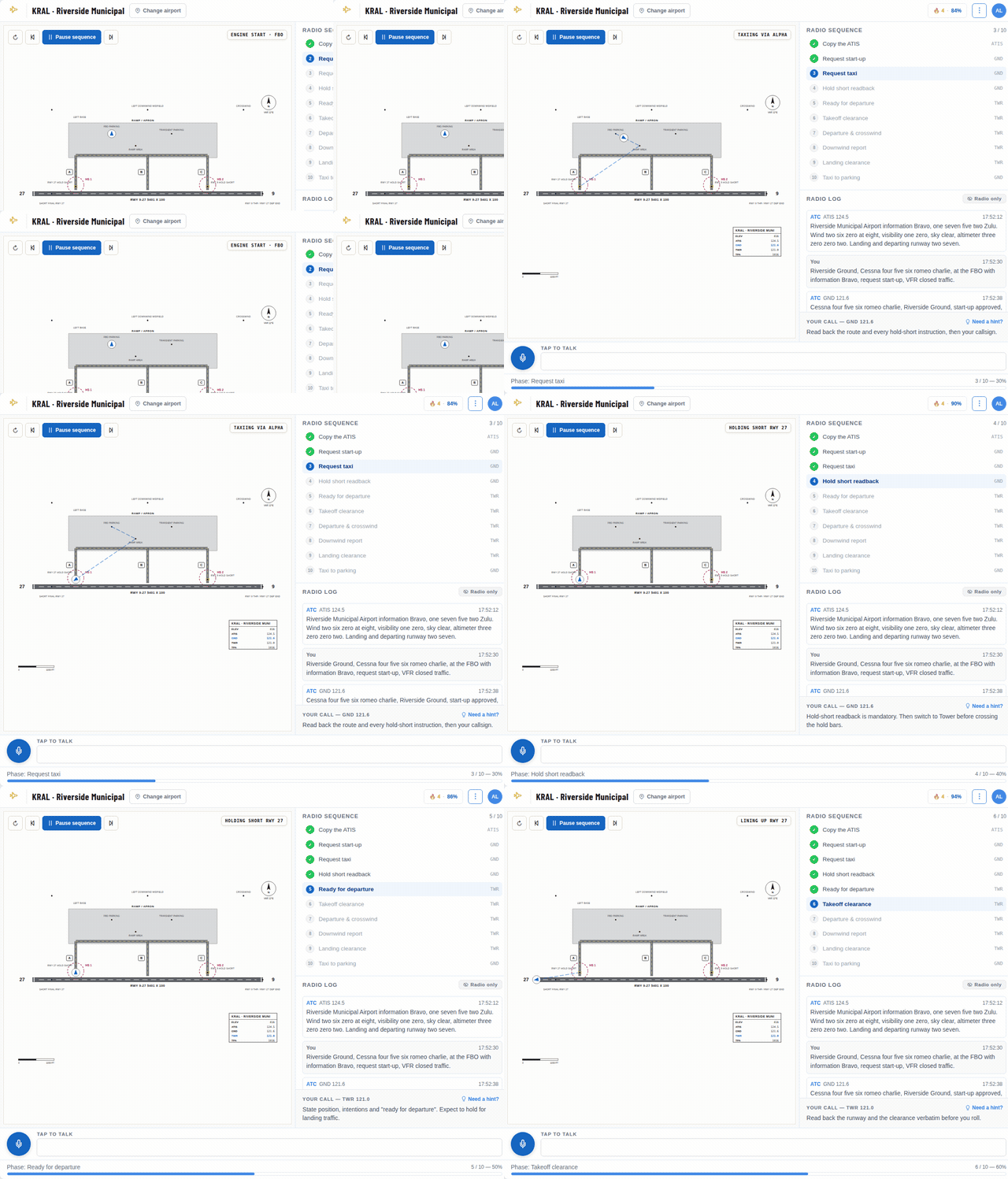
Put the chain together and a simple flight from a Class D airport to a practice area looks like this. You listen to the ATIS for the weather, runway and information letter. You call Ground for taxi and read back the hold-short. You switch to Tower at the runway, call ready, and read back the takeoff clearance. Leaving the airspace, Tower approves a frequency change, and if you want flight following you call Departure or Center.
Coming back, the order reverses: Approach or Center hands you off, you call Tower with the new ATIS letter about ten miles out, Tower sequences you to land, and after you clear the runway Ground takes you to parking. Four or five facilities, and every call built from the same four parts.
Why the Radio Feels Harder Than the Flying
Ask flight instructors where students get stuck and the radio comes up again and again. The words are simple. The hard part is saying them in the right order, at the right moment, while you are also taxiing, scanning for traffic and running a checklist. A controller who works a frequency all day hears the difference between a pilot who knows the format and one who is building each sentence from scratch.
The fix is repetition before the flight, out loud. Not reading the phrases silently from a card, but saying them into a microphone and hearing a reply you did not script. That is the part ground school rarely covers and the part that costs the most to learn in the airplane with the Hobbs meter running.
Practice the Chain Before You Fly It
The RadialCoach ATC simulator is built around this exact chain. You speak into your microphone, an AI controller answers in a radio voice, and each call is scored on what you included and what you missed. The eight free lessons are set at Riverside Municipal (KRAL), a Class D airport: a first contact call, copying the ATIS, calling Ground, calling Tower ready for takeoff, a full flight from ATIS to parking, the departure and arrival halves of that flight, and a Mayday for an engine failure on downwind.
The Pro lessons move up the chain into radar airspace: VFR flight following out of Van Nuys, a Class C arrival into John Wayne with SoCal Approach, and the Shoreline Route transition through the Los Angeles Class B. Each one adds a facility you have now read about, so the names in this article turn into voices you have already answered. It all runs in the browser at radialcoach.com/atc, with nothing to install.
The Voices Behind the Frequency
Behind every one of those frequencies is a person working a position, often for hours at a time, keeping track of a dozen aircraft that cannot see each other. Clear, short, correct calls are the most useful thing a pilot can give them. Learn who owns each piece of the sky, learn what each of them needs to hear, and the radio becomes another instrument you know how to use.